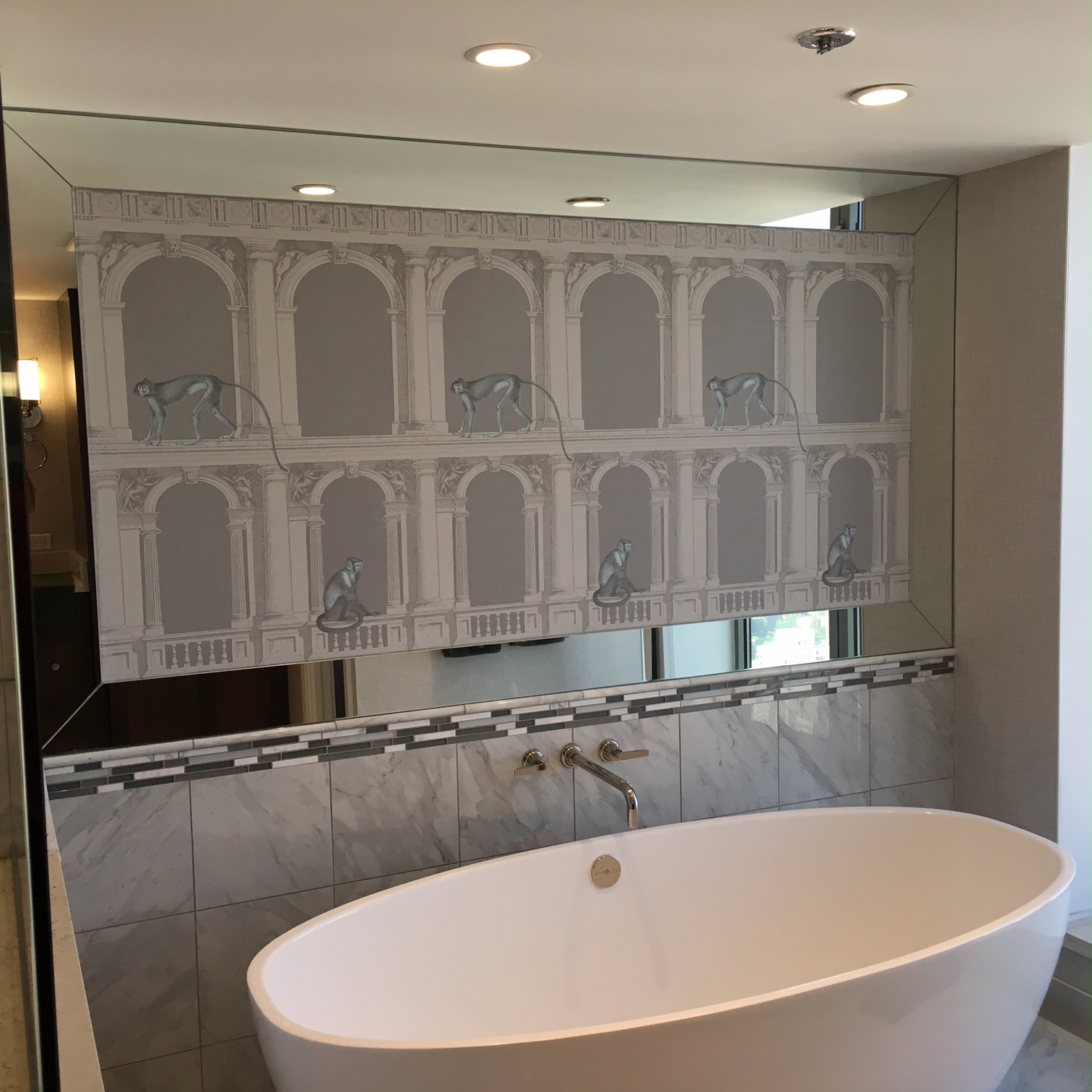
The walls are far too beautiful, and anything that hopes for a place in front of our walls will have to prove its worth first.
- Richard Medina, Palatine
Phone: (847)934-8885 Email: info@paintpartner.com Visit PIP's Facebook Page View Mario Guertin's LinkedIn Profile Follow PaintPartner on Twitter Subscribe to PaintPartner's RSS Feed

Archive for Wallpaper & Wall Covering

1927 Antique Wallpaper Book – Preserved

Saturday, August 6th, 2011

1927 Period Wallpaper Book

I recently purchased a wonderful 1927 book of wallpaper samples, borders and chair rail designs – in all over two hundred samples. The manufacturer was R. Fedderman & Sons, Inc. of Boston. Included in this post are a few samples of these period wallpapers. The first sample layered two different wallpapers. The first one showed scenes and the second one created framing for the scenes, making the room appear as if it were covered with artwork. How did the tradition of using wallpaper begin?

Starting in the Middle Ages, the nobility began to hang large tapestries to give more visual warmth and interest to their otherwise stern looking stone walls. However, the cost of tapestries was out of the reach of all but a few privileged people. Wars and other political issues also often interrupted the trade of such items. Not surprisingly, the first wallpapers that were made depicted scenes reminiscent of to those on the tapestries.

England and France were the early leaders in the manufacturing of wallpaper. In those days, wallpapers were hand printed using hand-carved blocks of paper, which was an ancient printing method. Today, Zuber at Cie. of France is the only known wallpaper manufacturer still producing wood-blocked wallpaper.

The Industrial Revolution transformed the wallpaper-making process. At the end of the eighteen century, a machine was inverted that made continuous lengths of wallpaper. Early in the nineteenth century, the first steam-powered printing presses were invented in England and made possible the mass production of inexpensive wallpapers, thereby making it available to the middle class. Those technologies were quickly brought over to the United States as well. By the time the twentieth century came along, wallpaper had become one of the most popular household-decorating items. It remained so for most of the century. In the late 1980’s, the emergence of Faux Finishing and the development of a myriad of new decorative finishing products and methods sent the wallpaper market into a major downspin, from which it has not recovered yet.

Period Wallpaper Circa 1927 - 1

Period Wallpaper Circa 1927 - 2

Period Wallpaper Circa 1927 - 3

Period Wallpaper Circa 1927 - 4

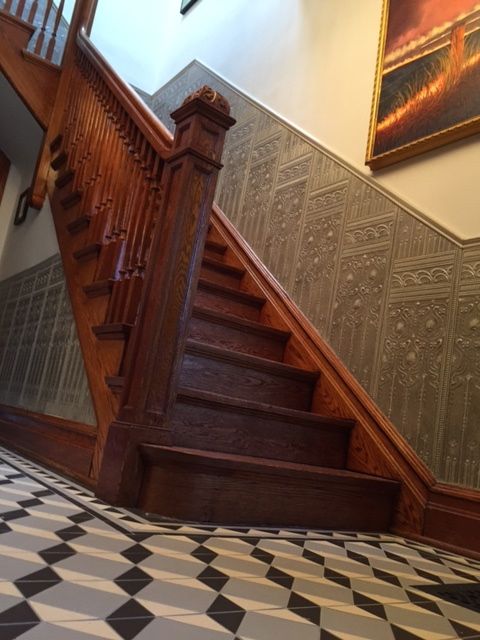
The Lincrusta wallcovering is a British invention of Frederick Walton, also the inventor for the Linoleum floor coverings. It was launched in 1877 and was originally fabricated in Sunbary-on-Thames. Today, this wallpaper is produced in Morecambe, in Lancashire, England, using traditional methods and many of the original rollers.

Lincrusta wallpapers met with immediate success and are still used today in the decoration of interior spaces all over the world. Lincrusta is a deeply embossed wallcovering and its reliefs are designed to imitate embossed leather or metal, as well as carved wood and plaster. Part of the reason for its popularity is that it made possible to have the look of very expensive decoration at a reasonable cost. Because of it rigidity and weight, Lincrusta came in sheets and was installed below chair rails and sometimes on ceilings. It was also designed as borders, friezes and dados.

Sample of Lincrusta Wallcovering from 1920's

Sample of Lincrusta Wallcovering from 1920's

The popularity of Lincrusta spread far and wide. It was used in homes, public and government buildings, railroad cars, even steamships like 6 luxury cabins on the Titanic and famous buildings like the White House and the John D. Rockefeller’s house in New York City. The Victorian era absolutely fell in love with Lincrusta.

It could be painted and decorated with glazes, even gold leaf. The ingredients for Lincrusta were linseed oil, resins and wood flour. As it aged, Lincrusta would harden, which gave it exceptional durability. This is why well-preserved examples of Lincrusta can be found all over the world today, like this sample from the 1920’s taken from a Chicago building on Clark street before it was demolished in the 1990’s.

Lincrusta is one of the many specialty wallcoverings that the craftsmen from Painting in Partnership from the Chicago install and decorate for its clients.